|
Ah,
History! A favorite subject of ours, here at Campy Only!
Why? Because the mystique of Campagnolo -- part of the
attraction of the world's finest cycling components, derives from
the history and tradition that started on a cold day in the
Italian Dolomites, some 70 years ago.
The view at left is of Teatro
Olimpico in
Vicenza, Italy--home city of Campagnolo and one of
Italy's most beautiful cities. To see more of Vicenza's historic
buildings: http://www.greatbuildings.com/places/vicenza.html
Click
here for our Campagnolo Timeline--Year-by-year history of the company
and its products
Classic Catalogs Online
Campagnolo's
"Record News" Archives
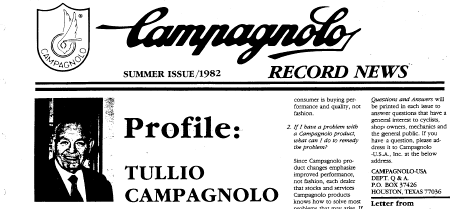
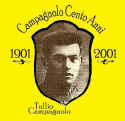
The history of Campagnolo begins in
1901, when Tullio Campagnolo was born into a
modest, working-class family in Vicenza, Italy. Tullio's father
owned a hardware store, and it was there that he began the
tinkering that would lead to many of the most momentous
developments in cycling history.
It was also during these early years that Tullio found cycling
-- a sport at which he found some success as an amateur,
competing in a number of major events, including Milan-San Remo,
Giro di Lombardia, and the preliminary heats of the Olympic
games.
 |
It was during one of Tullio's
races as an amateur that he confronted a problem which
often faced cyclists of those days -- removing a wheel.
On November 11th, 1927, with snow covering the roads of
the Italian Dolomite mountains (that's him in the photo,
on that very day!), Tullio was riding over the Croce
D'Aune Pass in the Gran Premio della Vittoria race and
needed to remove his rear wheel to change gears (more on
that below). Because the large wingnuts that held his
wheel on had frozen and his hands were too cold to budge
them, he was unable to remove his wheel to change gears,
and lost his chance at victory that day. As he struggled to free his
wheel, he muttered five words to himself that changed the
history of cycling:
"Bisogno cambiá qualcossa
de drio!"
|
|

Photo above: The Tullio Campagnolo
memorial at the Croce D'Aune pass. Photo by Allan
Nelson
|
Those words ("Something must change in the
rear!") and that simple event -- a wheel that couldn't be removed -- started Tullio thinking. He went
back to his workshop, and emerged with the invention of
the quick-release lever (in 1930) and, soon after, an early bicycle derailleur (1933). |
The quick release was only the first in
a long line of innovations that sprang from Campagnolo's
workshop. In fact, it was from his humble factory in Vicenza that
the very idea of a derailleur came to be. Can't image
what it was like to ride before Ergo shifting? Get a load of
this:
In the good old days, when
stages in the Tour de France were 300 miles long, and riders
ascended mountain passes over barely paved roads, there were
no derailleurs! In those days, bikes had either one gear
(one cog on the rear wheel) or two. Those two-speed bikes had one
cog on each side of the rear hub. To change gears, the rider
would dismount, remove the rear wheel, flip it around, tighten
the whole thing up again, remount, and continue riding. (The
riders in the photo are doing just this in a Tour de France photo
from the 1930s. They've ascended the Col d'Izoard pass, and are
getting ready to descend the other side in the higher gear.)
One measure of a cyclist's skill in those days was the speed with
which he (or, rarely, she) could do all that.
For tons of historic photos like this, check out one of
the most amazing sites we have yet found, at http://www.worldmedia.fr/tour/saga/histoire/index.html
You'll find a complete history of every stage of the Tour de
France, along with photos from each year's race, all the way back
to the turn of the century!
| Campagnolo
saw the potential for a different shifting system. In
1930,. he introduced the first quick-release hub,
answering the challenge he had made to himself three
years earlier. In
1940 he invented the dual-rod "Cambio Corsa"
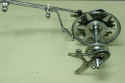
shifter (as pictured at right). The Cambio Corsa was
followed by the "Roubaix" shifter, which

combined the quick release and chain mover into a single
lever. The shifting was archaic by today's standards, but
it was widely used in the pro peloton for at least a decade, until the
introduction of Campagolo's "Gran Sport" derailleur in
1951. Here's how it worked: The
Cambio Corsa shifter consisted of two levers and rods,
attached to the right-side seatstay. One of the levers
actuated the quick release on the rear wheel, the other
moved a fork-like device that moved the chain from side
to side. There were no jockey pulleys or other takeup
mechanism on the chain. The rear dropouts were horizontal
and somewhat longer than they are today, since
"slack" in the chain was taken up by allowing
the wheel to move backward and forward.
|

Photo Source: CyberBike.com
More
Photos Here
|

Photo Source: CyberBike.com |
To shift, the rider would
first loosen the rear wheel's quick release (remember,
this is done while riding!). Then, the other
lever would be turned to move the chain from one cog to
the other -- as it moved, the rear wheel would move forward (when shifting to the larger cog) or backward
(shifting to the smaller cog). When the shift was
complete, the quick release was tightened again. The
great champion, Gino Bartali, was a
master of the rod shifter. He is shown here in a photo
from the 1948 Tour de France, reaching down to shift
while he ascends a high mountain pass.

These jigs were made to
facilitate the building of frames for the Cambio Corsa by keeping the
toothed dropouts aligned. Thanks to reader Steven
Maasland for these photos.
|
| The Roubaix shifter is today much rarer
than the Cambio Corsa because the Gran Sport design was
introduced shortly after, making its production window
pretty narrow. |
Here's a 1949 Frejus, a classic of
the era, equipped with the Cambio Corsa shift mechanism.
Interested in purchasing a bike like this? Check out the Vintage Velos web
site--they offer bicycles from the classic era.
|
 |

These photos show Tullio himself with an old rod-shifter
bike. Below is an excerpt from a Campagnolo catalog of
the era, showing the workings of the Cambio Corsa
shifter.
|
 |
 |
Campagnolo's rudimentary
derailleur revolutionized cycling. But it was only one in
a long line of technical innovations. |
Following World War II, many of the
world's best cyclists -- including Fausto Coppi (Il Campionissimo) and Gino Bartali -- began using Campagnolo's
equipment.
(That's Coppi, riding far ahead of the pack aboard a
Campy-equipped bike in the 1949 Tour de France.) Coppi rode Campagnolo's first rod-shifter
derailleur in the 1945 Paris-Roubaix race, and later used
Tullio's components to ride to victory in the 1950 Paris-Roubaix.
Tullio's next derailleur design looked very similar to those
would be used worldwide for the next few decades after. It
started the long line of innovations which leads directly to Ergo
shifting and the Record gruppo! Photo right, the first Gran Sport
derailleur, a dual-cable model that never saw production. The single-cable
Gran Sport was introduced in 1950; it was the first of many similar
derailleurs--its design lasted for more than 30 years, through the last C-Record
lines in the 1980s.
Campagnolo's
emergence as the definitive component manufacturer was due in
large part to the man himself, and to his concept of linking the
producer and the end user. Foreshadowing the R&D of today's
companies, Tullio began following the races personally, listening
to the suggestions of the riders and modifying the products to
meet their needs.
Important Dates In Campagnolo History
Read
our Campy Only Timeline--Your source for the history of the world's
greatest components
An Historical
Anecdote We Thought We'd Pass Along . . .
One of our faithful readers, who we will refer to as roblopez@erols.com came
across this interesting anecdote in a biography
of Eddy Merckx:
Walter Godefroot relates this story, which may be of
interest to our community:
Freddy Maertens and Walter Godefroot
were in a car familiarizing themselves with the course for
the 1973 world championship in Montjuich, when a car
containing Tullio Campagnolo came alongside.
Campagnolo asked who was going to win
the championship. Godefroot pointed to Maertens and said
"This one".
Campagnolo said:
"Oh God, no. Not him. He rides
with Shimano parts"
Gimondi, using Campagnolo parts, won
that day.
From the book: "Eddy Merckx, The
Greatest Cyclist of the 20th Century",
by Rik Vanwalleghem, English edition published by VeloPress,
1996, p. 51 (Find more about this book at the VeloNews web
site!)
|